
Resources for Researchers

Latest Publications by CAPES Faculty and Important Suicide Research to Practice Translation
You can also visit our repository of CAPES products (including our newsletters, tip sheets, reports, and publications) at the Lamar Soutter Library eScholarship page.
Manuals and Tip Sheets Produced by CAPES
Below you can find manuals produced by CAPES and tip sheets produced in collaboration with our CAPES Lived Experience Advisory Board (CLEAB).
Best Practices for Public Dissemination of Suicide Research
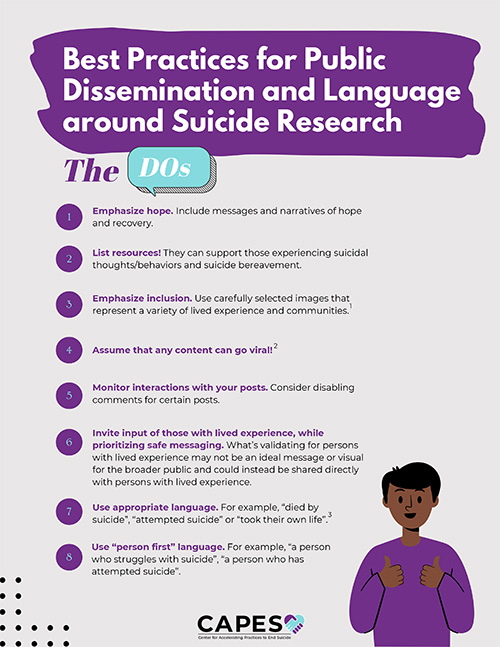
Many of us are aware of the media guidelines for responsible media reporting around suicide (e.g., from Reporting on Suicide, the World Health Organization, and Samaritans). Irresponsible communication around suicide in the media has been shown to increase risk and can even contribute to higher suicide rates (Niederkrotenthaler et al., 2012; 2020). As researchers, we have a part to play in responsible reporting and sharing of suicide research findings with the public.
Guidance for Researchers and Developers of Suicide Prevention Technology Tools

This tip sheet includes guidance for researchers working in digital health and technology tools for suicide prevention, as well as software developers and companies working in digital health for suicide prevention. These are not rules to follow, and instead are offered to center patient autonomy, choice, and transparency when offering digital tools. Suicide prevention refers to screening, assessment, risk management, and interventions.
The Use of Artificial Intelligence in Suicide Prevention and Mental Health Support

These are questions and guidance for researchers developing or applying for funding related to artificial intelligence for use in mental health and suicide prevention. Persons with a range of lived experiences—from acute to chronic suicidal despair—should be meaningfully included in the design and development of AI tools, to ensure the content is grounded in real world perspectives.
The Comprehensive Assessment for Risk of Suicide (CARS) User Manual

The Comprehensive Assessment for Risk of Suicide (CARS) was developed because, despite improvements in suicide risk measurement over the past 30 years, there was still no accepted gold standard instrument for the comprehensive assessment of suicide risk. The CARS is intended to act as the gold standard when a suicide risk assessment and stratification is needed. While the CARS conceptualizes suicide risk on a continuum or spectrum, a semi-structured approach is used to transform the information obtained into five suicide risk strata reflecting likelihood for suicide risk over the next 6 months: negligible, mild, moderate, high, or imminent risk. Currently, it is intended primarily as a semi-structured research instrument.
Publications on Suicide Prevention, Machine Learning, and Implementation Science
Click on the button below each publication for the FREE version in PubMedCentral.
AI and Person-Centered Design
Alrefaei, D., Djamasbi, S., & Strong, D. (2023). Chronic pain and eye movements: a neuroIS approach to designing smart clinical decision support systems. AIS Transactions on Human-Computer Interaction, 15(3), 268–291. https://doi.org/10.17705/1thci.00191
Amante, D. J., Shenette, L., Wainaina, S., Balakrishnan, K., Bhatia, S., Lee, J. A., Lemon, S. C., McManus, D., Harlan, D. M., Malkani, S., & Gerber, B. S. (2024). Digital health tools and behavioral strategies to increase engagement with diabetes self-management education and support: design and feasibility of DM-BOOST. The Science of Diabetes Self-management and Care, 50(6), 497–509. https://doi.org/10.1177/26350106241285829
Kitsiou, S., Gerber, B. S., Buchholz, S. W., Kansal, M. M., Sun, J., & Pressler, S. J. (2025). Patient-centered mHealth intervention to improve self-care in patients with chronic heart failure: phase 1 randomized controlled trial. Journal of Medical Internet Research, 27, e55586. https://doi.org/10.2196/55586
Ethics in Suicide Research
Klitzman, R., Pivovarova, E., & Lidz, C. W. (2017). Single IRBs in multisite trials: questions posed by the new NIH policy. JAMA, 317(20), 2061–2062. https://doi.org/10.1001/jama.2017.4624
Lawrence, R. E., Jaffe, C., Zhao, Y., Wang, Y., & Goldberg, T. E. (2024). Clinical trials studying suicide risk reduction: who is excluded from participation. Archives of Suicide Research: Official Journal of the International Academy for Suicide Research, 1–14. Advance online publication. https://doi.org/10.1080/13811118.2024.2322128
McInnis, B. J., Pindus, R., Kareem, D. H., Cakici, J., Vital, D. G., Hekler, E., & Nebeker, C. (2025). Using dataflow diagrams to support research informed consent data management communications: participant perspectives. Journal of the American Medical Informatics Association: JAMIA, 32(4), 712–723. https://doi.org/10.1093/jamia/ocaf004
Palmer, B. W., Arias, S. A., Dunlap, D. R., Gould, G. E., Rahmoun, M. B., Boudreaux, E. D., & Nebeker, C. (2025). The ethics of proximity: Enrolling patients in emergency department hallway beds for suicide research. Academic Emergency Medicine, 10.1111/acem.15107. Advance online publication. https://doi.org/10.1111/acem.15107
Implementation Science and Systems Level Issues
Isbell, L. M., Boudreaux, E. D., Chimowitz, H., Liu, G., Cyr, E., & Kimball, E. (2020). What do emergency department physicians and nurses feel? A qualitative study of emotions, triggers, regulation strategies, and effects on patient care. BMJ Quality & Safety, 29(10), 1–2. https://doi.org/10.1136/bmjqs-2019-010179
Isbell, L. M., Chimowitz, H., Huff, N. R., Liu, G., Kimball, E., & Boudreaux, E. (2023). A qualitative study of emergency physicians' and nurses' experiences caring for patients with psychiatric conditions and/or substance use disorders. Annals of Emergency Medicine, 81(6), 715–727. https://doi.org/10.1016/j.annemergmed.2022.10.014
Isbell, L. M., Le, V., Huff, N. R., Beals, K., Tager, J. B., Kimball, E., Whillock, S., & Boudreaux, E. D. (2025). Medical care for patients with mental health and/or substance-use disorders: a qualitative investigation of emergency department patient experiences and recommendations. Health Services Research, 60(4):e14617. https://doi.org/10.1111/1475-6773.14617
Larkin C. (2024). Implementation of suicide prevention activities at acute care discharge: time for change?. Joint Commission Journal on Quality and Patient Safety, S1553-7250(24)00118-1. Advance online publication. https://doi.org/10.1016/j.jcjq.2024.04.007
Larkin, C., Kiefe, C. I., Morena, A. L., Rahmoun, M. B., Lazar, P., Sefair, A. V., & Boudreaux, E. D. (2023). Clinician attitudes toward suicide prevention practices and their implementation: findings from the System of Safety Study. Psychiatric Services, appips20230082. https://doi.org/10.1176/appi.ps.20230082
Pisani, A. R., & Boudreaux, E. D. (2023). Systems Approach to Suicide Prevention: Strengthening Culture, Practice, and Education. Focus (American Psychiatric Publishing), 21(2), 152–159. https://doi.org/10.1176/appi.focus.20220081
Machine Learning, Health, and Suicide Risk Identification
Banerjee, S., Wu, Y., Bingham, K. S., Marino, P., Meyers, B. S., Mulsant, B. H., … Flint, A. J. (2024). Trajectories of remitted psychotic depression: identification of predictors of worsening by machine learning. Psychological Medicine, 54(6), 1142–1151. doi:10.1017/S0033291723002945
Boudreaux, E. D., Rundensteiner, E., Liu, F., Wang, B., Larkin, C., Agu, E., Ghosh, S., Semeter, J., Simon, G., & Davis-Martin, R. E. (2021). Applying machine learning approaches to suicide prediction using healthcare data: overview and future directions. Frontiers in Psychiatry, 12, 707916. https://doi.org/10.3389/fpsyt.2021.707916
Inekwe, T., Mkandawire, W. Wee, B. Agu, E. & Colubri, A. (2024) "Biomarker Trajectory Prediction and Causal Analysis of the Impact of the Covid-19 Pandemic on CVD Patients using Machine Learning," 2024 IEEE/ACM Conference on Connected Health: Applications, Systems and Engineering Technologies (CHASE), Wilmington, DE, USA, pp. 1–12, doi: 10.1109/CHASE60773.2024.00011
Keloth, V. K., Banda, J. M., Gurley, M., Heider, P. M., Kennedy, G., Liu, H., Liu, F., Miller, T., Natarajan, K., V Patterson, O., Peng, Y., Raja, K., Reeves, R. M., Rouhizadeh, M., Shi, J., Wang, X., Wang, Y., Wei, W. Q., Williams, A. E., Zhang, R., … Xu, H. (2023). Representing and utilizing clinical textual data for real world studies: An OHDSI approach. Journal of biomedical informatics, 142, 104343. https://doi.org/10.1016/j.jbi.2023.104343
Josselyn, N., Sawant, S., Davis-Martin, R. Rundensteiner, E., Gerber, B. S., Wang, B., Rothschild, A. J., Agu, E., Boudreaux, E., & Liu, F (2026). Evaluating model generalizability for suicide attempt risk prediction: traditional machine vs deep learning. npj Mental Health Research. https://doi.org/10.1038/s44184-026-00209-2
Predicting Suicide Risk During or After Emergency Department Visits or Hospitalization
Boudreaux, E. D., Ardelean, A. J., Ciminelli, J., Arias, S. A., Camargo, C. A., Jr., & Miller, I. W. (2025). Patients Who Screen Positive for Suicide Risk Incidental to Their Chief Complaint in the Emergency Department: Characteristics and Post-Visit Suicide Outcomes. Archives of Suicide Research, 1–21. https://doi.org/10.1080/13811118.2025.2574516
Boudreaux, E. D., Larkin, C., Kini, N., Capoccia, L., Allen, M. H., Goldstein Grumet, J., Silverman, M. M., McKeon, R., Barton, B., Miller, I., Formica, S. W., & Camargo, C. A. (2018). Predictive utility of an emergency department decision support tool in patients with active suicidal ideation. Psychological Services, 15(3), 270–278. https://doi.org/10.1037/ser0000236
Boudreaux, E. D., Larkin, C., Sefair, A. V., Mick, E., Clements, K., Pelletier, L., Yang, C., & Kiefe, C. (2022). Studying the implementation of zero suicide in a large health system: challenges, adaptations, and lessons learned. Contemporary Clinical Trials Communications, 30, 100999. https://doi.org/10.1016/j.conctc.2022.100999
Boudreaux, E. D., Larkin, C., Vallejo Sefair, A., Ma, Y., Li, Y. F., Ibrahim, A. F., Zeger, W., Brown, G. K., Pelletier, L., Miller, I., & ED-SAFE 2 Investigators (2023). Effect of an emergency department process improvement package on suicide prevention: The ED-SAFE 2 cluster randomized clinical trial. JAMA Psychiatry, 80(7), 665–674. https://doi.org/10.1001/jamapsychiatry.2023.1304
Boudreaux, E. D., Rundensteiner, E., Liu, F., Wang, B., Larkin, C., Agu, E., Ghosh, S., Semeter, J., Simon, G., & Davis-Martin, R. E. (2021). Applying machine learning approaches to suicide prediction using healthcare data: overview and future directions. Frontiers in Psychiatry, 12, 707916. https://doi.org/10.3389/fpsyt.2021.707916
Cullen, S. W., Olfson, M., Xie, M., & Marcus, S. C. (2024). Impact of emergency department safety planning on 30-day mental health service use. Psychiatric Services (Washington, D.C.), appips20230187. Advance online publication. https://doi.org/10.1176/appi.ps.20230187
Darnell, D., Pierson, A., Whitney, J. D., Wolkow, C. A., Dorsey, S., Boudreaux, E. D., Areán, P. A., & Comtois, K. A. (2023). Acute and intensive care nurses' perspectives on suicide prevention with medically hospitalized patients: Exploring barriers, facilitators, interests, and training opportunities. Journal of Advanced Nursing, 79(9), 3351–3369. https://doi.org/10.1111/jan.15650
Rabasco, A., Arias, S., Benz, M. B., Weinstock, L. M., Miller, I., Boudreaux, E. D., Camargo, C. A., Jr, Kunicki, Z. J., & Gaudiano, B. A. (2024). Longitudinal risk of suicide outcomes in people with severe mental illness following an emergency department visit and the effects of suicide prevention treatment. Journal of Affective Disorders, 347, 477–485. https://doi.org/10.1016/j.jad.2023.12.019
Roth, B., Chen, J. I., Nagarkatti-Gude, D. R., Pfeiffer, P. N., Newgard, C. D., Hynes, D. M., & Boudreaux, E. D. (2024). Adapting the Zero Suicide framework to the adult emergency department setting: strategies for nurse leaders. Archives of Psychiatric Nursing, 51, 76–81. https://doi.org/10.1016/j.apnu.2024.05.011
Ryan, P. C., Lowry, N. J., Boudreaux, E., Snyder, D. J., Claassen, C. A., Harrington, C. J., Jobes, D. A., Bridge, J. A., Pao, M., & Horowitz, L. M. (2024). Chronic pain, hopelessness, and suicide risk Among adult medical inpatients. Journal of the Academy of Consultation-Liaison Psychiatry, 65(2), 126–135. https://doi.org/10.1016/j.jaclp.2023.11.686
Scudder, A., Rosin, R., Baltich Nelson, B., Boudreaux, E. D., & Larkin, C. (2022). Suicide screening tools for pediatric emergency department patients: a systematic review. Frontiers in Psychiatry, 13, 916731. https://doi.org/10.3389/fpsyt.2022.916731
Simon, G. E., Johnson, E., Shortreed, S. M., Ziebell, R. A., Rossom, R. C., Ahmedani, B. K., Coleman, K. J., Beck, A., Lynch, F. L., & Daida, Y. G. (2024). Predicting suicide death after emergency department visits with mental health or self-harm diagnoses. General Hospital Psychiatry, 87, 13–19. https://doi.org/10.1016/j.genhosppsych.2024.01.009
Predicting Suicide Risk in Other Settings
Ayer, L., Horowitz, L. M., Colpe, L., Lowry, N. J., Ryan, P. C., Boudreaux, E., Little, V., Erban, S., Ramirez-Estrada, S., & Schoenbaum, M. (2022). Clinical pathway for suicide risk screening in adult primary care settings: special recommendations. Journal of the Academy of Consultation-Liaison Psychiatry, 63(5), 497–510. https://doi.org/10.1016/j.jaclp.2022.05.003
Bryan, C. J., Butner, J. E., May, A. M., Rugo, K. F., Harris, J., Oakey, D. N., Rozek, D. C., & Bryan, A. O. (2020). Nonlinear change processes and the emergence of suicidal behavior: a conceptual model based on the fluid vulnerability theory of suicide. New Ideas in Psychology, 57, 10.1016/j.newideapsych.2019.100758. https://doi.org/10.1016/j.newideapsych.2019.100758
Horowitz, L. M., Ryan, P. C., Wei, A. X., Boudreaux, E. D., Ackerman, J. P., & Bridge, J. A. (2023). Screening and Assessing Suicide Risk in Medical Settings: Feasible Strategies for Early Detection. Focus, 21(2), 145–151. https://doi.org/10.1176/appi.focus.20220086
Kelly, L. M., Alessi, S. M., Rash, C. J., & Zajac, K. (2024). Predictors of suicidal ideation and continued substance use problems among patients receiving methadone maintenance treatment who have co-occurring cocaine use disorder. Substance Use & Misuse, 59(5), 752–762. https://doi.org/10.1080/10826084.2024.2302131
Shepherd, B., Kelly, L. M., Brochu, P. M., Wolff, J., & Swenson, L. (2023). An examination of theory-based suicidal ideation risk factors in college students with multiple marginalized identities. American Journal of Orthopsychiatry. 93(2), 107–119. https://doi.org/10.1037/ort0000666
Raudales, A. M., Darosh, A. G., Contractor, A. A., Schatten, H. T., Dixon-Gordon, K. L., & Weiss, N. H. (2021). Positive emotion dysregulation identifies trauma-exposed community individuals at risk for suicide and nonsuicidal self-injury. The Journal of Nervous and Mental Disease, 209(6), 434–442. https://doi.org/10.1097/NMD.0000000000001316
Xiao, Y., Bi, K., Yip, P. S., Cerel, J., Brown, T. T., Peng, Y., Pathak, J., & Mann, J. J. (2024). Decoding suicide decedent profiles and signs of suicidal intent using latent class analysis. JAMA Psychiatry, e240171. Advance online publication. https://doi.org/10.1001/jamapsychiatry.2024.0171
Smartphone Technology, Suicide Risk, and Mental Health
Agu, E, Pedersen, P., Strong, D., Tulu, B., He Q., Wang, L., & Li, Y. (2013). "The smartphone as a medical device: Assessing enablers, benefits and challenges," 2013 IEEE International Workshop of Internet-of-Things Networking and Control (IoT-NC), New Orleans, LA, USA, pp. 48–52, https://doi.org/10.1109/IoT-NC.2013.6694053
Barrigon, M. L., Romero-Medrano, L., Moreno-Muñoz, P., Porras-Segovia, A., Lopez-Castroman, J., Courtet, P., Artés-Rodríguez, A., & Baca-Garcia, E. (2023). One-week suicide risk prediction using real-time smartphone monitoring: prospective cohort study. Journal of Medical Internet Research, 25, e43719. https://doi.org/10.2196/43719
Suicide Epidemiology
Kelly, L. M., Shepherd, B., Brochu, P. M., & Zajac, K. (2023). Co-occurring suicidal ideation and alcohol-related problems: an intersectional analysis of Native American and White adults with minoritized sexual identities. Addictive Behaviors. 107674. https://doi.org/10.1016/j.addbeh.2023.107674
Kelly, L. M., Shepherd, B. F., & Becker, S. J. (2021). Elevated risk of substance use disorder and suicidal ideation among Black and Hispanic lesbian, gay, and bisexual adults. Drug and Alcohol Dependence, 226, 108848. https://doi.org/10.1016/j.drugalcdep.2021.108848
Suicide Risk Interventions
Brown, L.A., Webster, J.L., Tran, J.T., Wolfe, J.R., Golinkoff, J., & Patel, E, et al. (2023). A suicide prevention intervention for emerging adult sexual and gender minority groups: protocol for a pilot hybrid effectiveness randomized controlled trial. JMIR Research Protocol. 12:e48177. https://doi.org/10.2196/48177
Chitavi, S. O., Patrianakos, J., Williams, S. C., Schmaltz, S. P., Ahmedani, B. K., Roaten, K., Boudreaux, E. D., & Brown, G. K. (2024). Evaluating the prevalence of four recommended practices for suicide prevention following hospital discharge. Joint Commission Journal on Quality and Patient Safety, S1553-7250(24)00067-9. Advance online publication. https://doi.org/10.1016/j.jcjq.2024.02.007
Darnell, D., Pierson, A., Tanana, M.J., Dorsey, S., Boudreaux, E.D., Areán, P. A, & Comtois, K.A. (2024). Harnessing innovative technologies to train nurses in suicide safety planning with hospital patients: formative acceptability evaluation of an eLearning continuing education training. JMIR Formative Research, 8, e56402. https://doi.org/10.2196/56402
David Rudd, M., Bryan, C. J., Jobes, D. A., Feuerstein, S., & Conley, D. (2022). A standard protocol for the clinical management of suicidal thoughts and behavior: implications for the suicide prevention narrative. Frontiers in psychiatry, 13, 929305. https://doi.org/10.3389/fpsyt.2022.929305
Dimeff, L. A., Jobes, D. A., Koerner, K., Kako, N., Jerome, T., Kelley-Brimer, A., Boudreaux, E. D., Beadnell, B., Goering, P., Witterholt, S., Melin, G., Samike, V., & Schak, K. M. (2021). Using a tablet-based app to deliver evidence-based practices for suicidal patients in the emergency department: pilot randomized controlled trial. JMIR Mental Health, 8(3), e23022. https://doi.org/10.2196/23022
Dunlap, L. J., Orme, S., Zarkin, G. A., Arias, S. A., Miller, I. W., Camargo, C. A., Jr, Sullivan, A. F., Allen, M. H., Goldstein, A. B., Manton, A. P., Clark, R., & Boudreaux, E. D. (2019). Screening and intervention for suicide prevention: a cost-effectiveness analysis of the ED-SAFE interventions. Psychiatric Services, 70(12), 1082–1087. https://doi.org/10.1176/appi.ps.201800445
Larkin, C., Djamasbi, S., Boudreaux, E. D., Varzgani, F., Garner, R., Siddique, M., Pietro, J., & Tulu, B. (2023). ReachCare mobile apps for patients experiencing suicidality in the emergency department: development and usability testing using mixed methods. JMIR Formative Research, 7, e41422. https://doi.org/10.2196/41422
Larkin, C., Tulu, B., Djamasbi, S., Garner, R., Varzgani, F., Siddique, M., Pietro, J., & Boudreaux, E. D. (2023). Comparing the acceptability and quality of intervention modalities for suicidality in the emergency department: randomized feasibility trial. JMIR Mental Health, 10, e49783. https://doi.org/10.2196/49783
McKleroy, V. S., Galbraith, J. S., Cummings, B., Jones, P., Harshbarger, C., Collins, C., Gelaude, D., Carey, J. W., & ADAPT Team (2006). Adapting evidence-based behavioral interventions for new settings and target populations. AIDS Education and Prevention, 18(4 Suppl A), 59–73. https://doi.org/10.1521/aeap.2006.18.supp.59
Wingood, G. M., & DiClemente, R. J. (2008). The ADAPT-ITT model: a novel method of adapting evidence-based HIV Interventions. Journal of Acquired Immune Deficiency Syndromes (1999), 47 Suppl 1, S40–S46. https://doi.org/10.1097/QAI.0b013e3181605df1
Publications on CAPES Projects
Click on the button below each publication for the FREE version in PubMedCentral.
Emergency Department Safety Assessment and Follow-up Evaluation (ED-SAFE)
Ting, S. A., Sullivan, A. F., Miller, I., Espinola, J. A., Allen, M. H., Camargo, C. A., Jr., Boudreaux, E. D., & Emergency Department Safety and Follow-up Evaluation (ED-SAFE) Investigators. (2012). Multicenter study of predictors of suicide screening in emergency departments. Academic Emergency Medicine: Official Journal of the Society for Academic Emergency Medicine, 19(2), 239–243. https://doi.org/10.1111/j.1553-2712.2011.01272.x
Ting, S. A., Sullivan, A. F., Boudreaux, E. D., Miller, I., & Camargo, C. A., Jr. (2012). Trends in US emergency department visits for attempted suicide and self-inflicted injury, 1993–2008. General Hospital Psychiatry, 34(5), 557–565. https://doi.org/10.1016/j.genhosppsych.2012.03.020
Caterino, J. M., Sullivan, A. F., Betz, M. E., Espinola, J. A., Miller, I., Camargo, C. A., Jr, Boudreaux, E. D., & Emergency Department Safety Assessment and Follow-up Evaluation (ED-SAFE) Investigators. (2013). Evaluating current patterns of assessment for self-harm in emergency departments: A multicenter study. Academic Emergency Medicine: Official Journal of the Society for Academic Emergency Medicine, 20(8), 807–815. https://doi.org/10.1111/acem.12188
Boudreaux, E. D., Miller, I., Goldstein, A. B., Sullivan, A. F., Allen, M. H., Manton, A. P., Arias, S. A., & Camargo, C. A., Jr. (2013). The Emergency Department Safety Assessment and Follow-up Evaluation (ED-SAFE): Method and design considerations. Contemporary Clinical Trials, 36(1), 14–24. https://doi.org/10.1016/j.cct.2013.05.008
Betz, M. E., Miller, M., Barber, C., Miller, I., Sullivan, A. F., Camargo, C. A., Jr., Boudreaux, E. D., & ED-SAFE Investigators. (2013). Lethal means restriction for suicide prevention: Beliefs and behaviors of emergency department providers. Depression and Anxiety, 30(10), 1013–1020. https://doi.org/10.1002/da.22075
Betz, M. E., Sullivan, A. F., Manton, A. P., Espinola, J. A., Miller, I., Camargo, C. A., Jr., Boudreaux, E. D., & ED-SAFE Investigators. (2013). Knowledge, attitudes, and practices of emergency department providers in the care of suicidal patients. Depression and Anxiety, 30(10), 1005–1012. https://doi.org/10.1002/da.22071
Betz, M. E., Schwartz, R., & Boudreaux, E. D. (2013). Unexpected suicidality in an older individual in an emergency department. Journal of the American Geriatrics Society, 61(6), 1044–1045. https://doi.org/10.1111/jgs.12290
Arias, S. A., Zhang, Z., Hillerns, C., Sullivan, A. F., Boudreaux, E. D., Miller, I., & Camargo, C. A. (2014). Using structured telephone follow-up assessments to improve suicide-related adverse event detection. Suicide & Life-threatening Behavior, 44(5), 537–547. https://doi.org/10.1111/sltb.12088
Bredemeier, K., & Miller, I. W. (2015). Executive function and suicidality: A systematic qualitative review. Clinical Psychology Review, 40, 170–183. https://doi.org/10.1016/j.cpr.2015.06.005
Betz, M. E., Arias, S. A., Miller, M., Barber, C., Espinola, J. A., Sullivan, A. F., Manton, A. P., Miller, I., Camargo, C. A., Jr., & Boudreaux, E. D. (2015). Change in emergency department providers' beliefs and practices after use of new protocols for suicidal patients. Psychiatric Services (Washington, D.C.), 66(6), 625–631. https://doi.org/10.1176/appi.ps.201400244
Arias, S. A., Sullivan, A. F., Miller, I., Camargo, C. A., Jr., & Boudreaux, E. D. (2015). Implementation and use of a crisis hotline during the treatment as usual and universal screening phases of a suicide intervention study. Contemporary Clinical Trials, 45(Pt. B), 147–150. https://doi.org/10.1016/j.cct.2015.08.015
Boudreaux, E. D., Camargo, C. A., Jr, Arias, S. A., Sullivan, A. F., Allen, M. H., Goldstein, A. B., Manton, A. P., Espinola, J. A., & Miller, I. W. (2016). Improving Suicide Risk Screening and Detection in the Emergency Department. American Journal of Preventive Medicine, 50(4), 445–453. https://doi.org/10.1016/j.amepre.2015.09.029
Betz, M. E., Arias, S. A., Segal, D. L., Miller, I., Camargo, C. A., Jr., & Boudreaux, E. D. (2016). Screening for Suicidal Thoughts and Behaviors in Older Adults in the Emergency Department. Journal of the American Geriatrics Society, 64(10), e72–e77. https://doi.org/10.1111/jgs.14529
Betz, M. E., Miller, M., Barber, C., Beaty, B., Miller, I., Camargo, C. A., Jr., & Boudreaux, E. D. (2016). Lethal means access and assessment among suicidal emergency department patients. Depression and Anxiety, 33(6), 502–511. https://doi.org/10.1002/da.22486
Arias, S. A., Miller, I., Camargo, C. A., Jr., Sullivan, A. F., Goldstein, A. B., Allen, M. H., Manton, A. P., & Boudreaux, E. D. (2016). Factors Associated With Suicide Outcomes 12 Months After Screening Positive for Suicide Risk in the Emergency Department. Psychiatric Services (Washington, D.C.), 67(2), 206–213. https://doi.org/10.1176/appi.ps.201400513
Arias, S. A., Dumas, O., Sullivan, A. F., Boudreaux, E. D., Miller, I., & Camargo, C. A., Jr. (2016). Substance Use as a Mediator of the Association Between Demographics, Suicide Attempt History, and Future Suicide Attempts in Emergency Department Patients. Crisis, 37(5), 385–391. https://doi.org/10.1027/0227-5910/a000380
Miller, I. W., Camargo, C. A., Jr., Arias, S. A., Sullivan, A. F., Allen, M. H., Goldstein, A. B., Manton, A. P., Espinola, J. A., Jones, R., Hasegawa, K., Boudreaux, E. D., & ED-SAFE Investigators. (2017). Suicide Prevention in an Emergency Department Population: The ED-SAFE Study. JAMA Psychiatry, 74(6), 563–570. https://doi.org/10.1001/jamapsychiatry.2017.0678
Boudreaux, E. D., Brown, G. K., Stanley, B., Sadasivam, R. S., Camargo, C. A., Jr., & Miller, I. W. (2017). Computer Administered Safety Planning for Individuals at Risk for Suicide: Development and Usability Testing. Journal of Medical Internet Research, 19(5), e149. https://doi.org/10.2196/jmir.6816
Arias, S. A., Boudreaux, E. D., Segal, D. L., Miller, I., Camargo, C. A., Jr., & Betz, M. E. (2017). Disparities in Treatment of Older Adults with Suicide Risk in the Emergency Department. Journal of the American Geriatrics Society, 65(10), 2272–2277. https://doi.org/10.1111/jgs.15011
Boudreaux, E. D., Larkin, C., Kini, N., Capoccia, L., Allen, M. H., Goldstein Grumet, J., Silverman, M. M., McKeon, R., Barton, B., Miller, I., Formica, S. W., & Camargo, C. A., Jr. (2018). Predictive utility of an emergency department decision support tool in patients with active suicidal ideation. Psychological Services, 15(3), 270–278. https://doi.org/10.1037/ser0000236
Dunlap, L. J., Orme, S., Zarkin, G. A., Arias, S. A., Miller, I. W., Camargo, C. A., Jr., Sullivan, A. F., Allen, M. H., Goldstein, A. B., Manton, A. P., Clark, R., & Boudreaux, E. D. (2019). Screening and Intervention for Suicide Prevention: A Cost-Effectiveness Analysis of the ED-SAFE Interventions. Psychiatric Services (Washington, D.C.), 70(12), 1082–1087. https://doi.org/10.1176/appi.ps.201800445
Assari, S., Schatten, H. T., Arias, S. A., Miller, I. W., Camargo, C. A., Jr., & Boudreaux, E. D. (2019). Higher Educational Attainment is Associated with Lower Risk of a Future Suicide Attempt Among Non-Hispanic Whites but not Non-Hispanic Blacks. Journal of Racial and Ethnic Health Disparities, 6(5), 1001–1010. https://doi.org/10.1007/s40615-019-00601-z
Arias, S. A., Boudreaux, E. D., Chen, E., Miller, I., Camargo, C. A., Jr., Jones, R. N., & Uebelacker, L. (2019). Which Chart Elements Accurately Identify Emergency Department Visits for Suicidal Ideation or Behavior? Archives of Suicide Research: Official Journal of the International Academy for Suicide Research, 23(3), 382–390. https://doi.org/10.1080/13811118.2018.1472691
Brown, L. A., Boudreaux, E. D., Arias, S. A., Miller, I. W., May, A. M., Camargo, C. A., Jr., Bryan, C. J., & Armey, M. F. (2020). C-SSRS performance in emergency department patients at high risk for suicide. Suicide & Life-threatening Behavior, 50(6), 1097–1104. https://doi.org/10.1111/sltb.12657
Boudreaux, E. D., Larkin, C., Camargo, C. A., Jr., & Miller, I. W. (2020). Validation of a Secondary Screener for Suicide Risk: Results from the Emergency Department Safety Assessment and Follow-up Evaluation (ED-SAFE). Joint Commission Journal on Quality and Patient Safety, 46(6), 342–352. https://doi.org/10.1016/j.jcjq.2020.03.008
Rabasco, A., Arias, S., Benz, M. B., Weinstock, L. M., Miller, I., Boudreaux, E. D., Camargo, C. A., Jr., Kunicki, Z. J., & Gaudiano, B. A. (2024). Longitudinal risk of suicide outcomes in people with severe mental illness following an emergency department visit and the effects of suicide prevention treatment. Journal of Affective Disorders, 347, 477–485. https://doi.org/10.1016/j.jad.2023.12.019
Benz, M. B., Rafferty, N. S., Arias, S. A., Rabasco, A., Miller, I., Weinstock, L. M., Boudreaux, E. D., Camargo, C. A., Jr, & Gaudiano, B. A. (2025). Means to an end: Characteristics and follow-up of emergency department patients with a history of suicide attempt via medication overdose. Academic Emergency Medicine: Official Journal of the Society for Academic Emergency Medicine, 32(2), 147–157. https://doi.org/10.1111/acem.15023
Emergency Department Safety Assessment and Follow-up Evaluation 2 (ED-SAFE 2)
Boudreaux, E. D., Haskins, B. L., Larkin, C., Pelletier, L., Johnson, S. A., Stanley, B., Brown, G., Mattocks, K., & Ma, Y. (2020). Emergency department safety assessment and follow-up evaluation 2: An implementation trial to improve suicide prevention. Contemporary Clinical Trials, 95, 106075. https://doi.org/10.1016/j.cct.2020.106075
Pisani, A. R., & Boudreaux, E. D. (2023). Systems Approach to Suicide Prevention: Strengthening Culture, Practice, and Education. Focus (American Psychiatric Publishing), 21(2), 152–159. https://doi.org/10.1176/appi.focus.20220081
Boudreaux, E. D., Larkin, C., Vallejo Sefair, A., Ma, Y., Li, Y. F., Ibrahim, A. F., Zeger, W., Brown, G. K., Pelletier, L., Miller, I., & ED-SAFE 2 Investigators. (2023). Effect of an Emergency Department Process Improvement Package on Suicide Prevention: The ED-SAFE 2 Cluster Randomized Clinical Trial. JAMA Psychiatry, 80(7), 665–674. https://doi.org/10.1001/jamapsychiatry.2023.1304
Boudreaux, E. D., Ardelean, A. J., Ciminelli, J., Arias, S. A., Camargo, C. A., Jr., & Miller, I. W. (2025). Patients Who Screen Positive for Suicide Risk Incidental to Their Chief Complaint in the Emergency Department: Characteristics and Post-Visit Suicide Outcomes. Archives of Suicide Research, 1–21. https://doi.org/10.1080/13811118.2025.2574516
Systems of Safety (SOS)
Boudreaux, E. D., Rundensteiner, E., Liu, F., Wang, B., Larkin, C., Agu, E., Ghosh, S., Semeter, J., Simon, G., & Davis-Martin, R. E. (2021). Applying Machine Learning Approaches to Suicide Prediction Using Healthcare Data: Overview and Future Directions. Frontiers in Psychiatry, 12, 707916. https://doi.org/10.3389/fpsyt.2021.707916
Boudreaux, E. D., Larkin, C., Sefair, A. V., Mick, E., Clements, K., Pelletier, L., Yang, C., & Kiefe, C. (2022). Studying the implementation of Zero Suicide in a large health system: Challenges, adaptations, and lessons learned. Contemporary Clinical Trials Communications, 30, 100999. https://doi.org/10.1016/j.conctc.2022.100999
Pisani, A. R., & Boudreaux, E. D. (2023). Systems Approach to Suicide Prevention: Strengthening Culture, Practice, and Education. Focus (American Psychiatric Publishing), 21(2), 152–159. https://doi.org/10.1176/appi.focus.20220081
Larkin, C., Kiefe, C. I., Morena, A. L., Rahmoun, M. B., Lazar, P., Sefair, A. V., & Boudreaux, E. D. (2024). Clinician Attitudes Toward Suicide Prevention Practices and Their Implementation: Findings From the System of Safety Study. Psychiatric Services (Washington, D.C.), 75(6), 534–542. https://doi.org/10.1176/appi.ps.20230082
Technology-Assisted Systems Change for Suicide Prevention (TASCS)
Larkin, C., Djamasbi, S., Boudreaux, E. D., Varzgani, F., Garner, R., Siddique, M., Pietro, J., & Tulu, B. (2023). ReachCare Mobile Apps for Patients Experiencing Suicidality in the Emergency Department: Development and Usability Testing Using Mixed Methods. JMIR Formative Research, 7, e41422. https://doi.org/10.2196/41422
Larkin, C., Tulu, B., Djamasbi, S., Garner, R., Varzgani, F., Siddique, M., Pietro, J., & Boudreaux, E. D. (2023). Comparing the Acceptability and Quality of Intervention Modalities for Suicidality in the Emergency Department: Randomized Feasibility Trial. JMIR Mental Health, 10, e49783. https://doi.org/10.2196/49783
Telehealth to Improve Prevention of Suicide (TIPS)
Khanna, A., Larkin, C., Davis-Martin, R., Micklus, I. K., Sefair, A. V., Roy, A., Klaucke, C. G., Reznek, M. A., & Boudreaux, E. D. (2025). Patient and health care provider experiences with suicide-related tele-mental health evaluations in the emergency department: multiphase qualitative study. JMIR mental health, 12, e72541. https://doi.org/10.2196/72541

Check Out the Other Practice Based Suicide Prevention Research Centers
CAPES is one of many Practice Based Suicide Prevention Research Centers funded by the NIMH. Check out each of the websites for the Centers. We seek to amplify and complement their work, and all rapidly advance the science and bridge the research to practice gap in suicide prevention.
- Pittsburgh ETUDES: www.etudescenter.org
- UW SCRC: https://psychiatry.uw.edu/research/suicide-care-research-center/
- Penn INSPIRE: https://www.med.upenn.edu/INSPIRE
- Michigan State NCHATs: nchats.org
- Mass General CSRP: https://www.massgeneral.org/psychiatry/research/center-for-suicide-research-prevention
- Nationwide Children’s ASPIRES: https://www.nationwidechildrens.org/sites/aspires